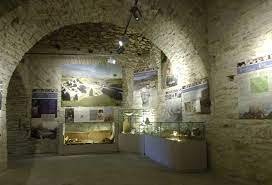
Gjirokastër Museum Gjirokaster
Rruga Gjin Bue Shpata
Gjirokaster Gjirokastër County
Albania
19:00
19:00
19:00
19:00
19:00
19:00
19:00
Are you the owner of this business?
Suggest an edit
Museum


Gjirokastër Museum Gjirokaster
DETAILS
Chronicle in stone (Point)
“It was a strange city, and seemed to have been cast up in the valley one winter’s night like some prehistoric creature that was now clawing its way up the mountainside. Everything in the city was old and made of stone, from the streets and fountains to the roofs of the sprawling age-old houses covered grey slates like gigantic scales. It was hard to believe that under this powerful carapace the tender flesh of life survived and reproduced…” Ismail Kadare, “Chronicle in stone”
Stone age – iron age... ... (Point)
Twenty – thousand years ago hunter – gatherers mined flints for fools and weapons in the Goranxi Gorge. These flint mines have been of great regional importance since prehistoric times. During the Ottoman period, they were highly prized as gunflints and even as late as the 20th century local people used them as fire lighters. In the Bronze and Iron Ages (1500-600 BC), the fertile pastures of the valley supported farming communities. Burial mounds, or tumuli, can still be seen. Small stone – walled forts, such as Pepel, Labova e Kryqit, Sotira and Selcka, were built on the side of the valley for the local villagers to take shelter during times of war.
Antigonea (Point)
The city of Antigonea flourished from the 4th -2 nd centuries BC. Antigonea was founded during the lifetime of King Pyrrhus (319-272 BC) and named after his wife Antigone, who was the stepdaughter of King Ptolemy of Egypt. Built on a flat hilltop, the city follows a classical town plan: it had defensive walls, an acropolis (a citadel) , an agora ( the centre of trade and social life) and a regular grid of streets. Antigonea was allied to the Kingdom of Macedonia in its wars against the Romans. Following the defeat of King Philip V of Macedonia in 168 BC, the Roman consul, Aemilius Paullus, ordered the destruction of the city. The Romans burned the buildings, demolished the walls and sold the inhabitants into slavery. Modern excavations have found a thick layer of ash all over the city – evidence of the violence of the destruction.
Hadrianopolis (Point)
In the 2 nd century AD, the Roman emperor, Hadrian, decided to revive this area by founding a new town, Hadrianopolis, on the valley floor. It united the communities that were scattered after the destruction of Antigonea, 300 years previously, and served as an important waypoint along a subsidiary of the Roman Via Egnatia. Hadrianopolis was a small city with a series of public buildings including a forum, theatre and baths. It is highly probable that the emperor, Justinian, renamed the city in the 6th century Justianopolis, and made it the seat of the local bishop. This would be the city’s last glory before its final abandonment due to flooding and the growing insecurity following the end of the Pax Romana.
The grave (Point)
This grave, containing the skeletons of two children, was discovered in 2011 within Hadrianopolis and dates from approximately the 6th century. The children were unearthed from a Cappucina tomb made of three curved roof-tiles, with one tile used as a base and the remaining two forming a chamber. While little is known about the children’s exact age, their sex or how they died, archaeologists have deduced the smaller child was less than six years old; a fact attributed to the presence of milk teeth and a permanent tooth developing within the jaw bone. The unusual burial of two children within one tomb and its location, being so cloe to a major public building rather than in a cemetery outside the city center, suggests well-ordered urban life at Hadrianopolis was breaking down.
Gjirokastra’s stones... ... (Point)
Anyone who’s ever walked the streets of Gjirokastra in the rain will tell you to always step on the black cobbles. But why? That’s because the black stones (below, far, left) are made of sedimentary rock – sand, grit, and dust formed over 100 million years of intense pressure. The black stones have a rough texture and the sole of your shoe has something to grip when you step on them. The grey stone, next to the black one, is actually the same type of rock – only younger. These young rocks are found in great ribbons up to four meters thick and break into thin sheets. They are used as roof tiles throughout the Old City of Gjirokastra. But what about those white and pink stones (below right)? The cause for their slippery nature is due to their partially crystalline structure, which gives them a glassy surface. They tend to shatter under pressure, so they are rarely used for building, although they are used for road cobbles and to decorate gateway arches.
Powerful feudal fami... ... (Point)
While part of the Ottoman Empire, Gjirokastra’s local affairs were ruled by several powerful feudal families, given the titles bey and agha. According to contemporary accounts, they were often in conflict and property changed hands regularly. The traveller and diplomat Francois Pouqueville (1770-1838) describes visiting in the early 1800s: “We set forward for Argyro-Castro. When we reached some springs which break out from the rocks under that town, we found a party of Albanian soldiers dressed in jackets of velvet, embroidered with gold and completely armed, sent down by Mourtaza – bey to escort me to his house. The opposing parties in the town being then in open war, one of the escort passed on before me, to acquaint the several chiefs of my approach; and the firing ceased, not only during our passage through the town, but for the whole of the day. Mourtaza, I found entrenched with his vassals in his castle, armed from top to toe like the warriors of days of yore…”
Oven (Point)
This bread oven was discovered in 2010 while this space was being renovated. It suggests that these galleries were used as kitchens and dining halls for the garrison of the town. Similar ovens in the basement of the castle would have provided enough bread for vast numbers of troops to live here. This type of oven is still used for baking. Compare it to Daut Baxhella’s bakery (below) in the bazaar.
The ruler (Point)
In 1811, Gjirokastra was captured by the brilliant and ruthless Ali Pasha, the most famous Albanian of the age. Ali was born in the nearly 1740s near the small town of Tepelena, in the Drino Valley. He rose to become the regional governor – pasha – of Ioannina and his vast territory included large parts of Albania and northern Greece. His twin capitals were at Ioannina and Tepelena. While he committed great atrocities, he developed the region by building fortifications, roads and bridges, and encouraging trade. Although an Ottoman governor, he became increasingly independent and powerful, often challenging the sultan’s rule. Eventually, the sultan sent a large army and after two years of fighting, Ali Pasha was trapped and executed on an island in Lake Ioannina in 1822. His head was taken to Istanbul.
The pasha’s castle (Point)
Ali Pasha seized Gjirokastra in 1811 in order to eliminate his rivals and control the Drino Valley. Ali Pasha directed his chief architect, Petro Korcari, to embark on a massive building programme to expand the castle. He added new fortifications, the clock tower and built an aqueduct to bring water 12 kilometres from a mountain spring to fill the giant cisterns within the castle. This would allow its inhabitants to withstand a siege. This vast fortress could house 5,000 soldiers, along with their munitions and supplies. The castle was equipped with 85 artillery pieces, mainly British, which were considered the best of their time. Yet, for all these new fortifications and firepower, Gjirokastra’s castle never faced attack during Ali Pasha’s lifetime. In 1820, Ali’s son, Myftar Pasha, handed the castle over the Ottoman army in exchange for sparing his life.
Evliya celebi (Point)
The Ottoman official travelled all over the Empire in the 17th century. He arrived in Gjirokastra in 1670 and his diaries provide the first colourful account of everyday life. “If someone in the town of Gjirokastra should happen to have a pimple or a boil, all the people say that he has the plague and flee from him… No one enters the home of anyone who has had the plague for up to two years, and even when this period has passed, they still cleanse the house with vinegar, disinfect it with various aromatic herbs, tear down and rebuild various parts of the house, and whitewash all the rooms with lime before entering. …the people here live long lives. There are those here who reach 170 years old and are still going strong, though somewhat reduced in vigour.”
Francois pouqueville... ... (Point)
Francois Pouqueville, writer and French diplomat to the Ottoman Court, visited Gjirokastra at the beginning of the 19th century: “…Argyro-Castro, which I found distracted with sanguinary and endless contentions, is situated on three spurs from the mountains on the west… On these rugged summits are erected the houses, some even adhering to the precipices like swallow’s nests. Solidly built of stone, the dwellings are pierced with loop holes, and, according to the wealth of the masters, enclosed within embattled walls flanked by towers. The more difficult of access, the more a house is valued. Bridges are thrown over the ravines for communication; others to support some projecting part of a building. The strange assemblage of towers, extravagant edifices, houses suspended in the air, or on the edges of rocks and precipices, well accorded with the state of hostilities in which the people live…”
Lord byron (Point)
The Romantic poet Lord Byron visited Ali Pasha at Tepelena in 1809. He wrote about his experience in the epic poem Childe Harold’s Pilgrimage: “…The sun had sunk behind vast Tomerit, The Laos wide and fierce came roaring by; The shades of wonted night were gathering yet, When, down the steep banks winding wearily Childe Harold saw, like meteors in the sky, The glittering minarets of Tepalen, Whose walls o’erlook the stream; and drawing high, He heard the busy hum of warrior-men Swelling the breeze that sighed Along the lengthening glen…
Edward lear (Point)
The English landscape painter and poet, Edward Lear, passed through Gjirokastra in 1848 and again in 1859, during his Balkan journeys. He stayed in a guest house in the centre of Gjirokastra and was delighted by the life he witnessed: “…But hark! Wailing again! The quiet of the hill city is suddenly broken and all the world of Arghyro Kastro is startled with the ill-omened cries! Heavens! What howls! Is all the Epirote city going distraught? The cause of all this is news has just been received that one of the principal Arghyro Kastriote merchants has died suddenly at Stamboul. The Cogia is chanting from the mosque opposite, a few wild notes, most impressively sad as they rise… Then the immediate family of the deceased swell of the chorus, yodeling and shrieking with deafening clamour, and wonderful cries, half sob, half piercing howls; house after house takes up the doleful tale, and in less than an hour the melody of grief pervades the whole place, bursting forth from crags above and resounding from depths below – shrill and solemn, bass and treble – one general lamentation and woe.”
Masters of stone (Point)
Ali Pasha not only commissioned castles, but also roads, bridges and aqueducts. The success of these projects rested as much on the power of Ali’s authority as on the skill of the local stonemasons. The stonemasons from this region were famous throughout the Ottoman Empire for their skill in creating tall stone arches, graceful bridges, aqueducts and public fountains, some of which can still be seen in Gjirokastra and the surrounding region. The 17th century traveller Celebi remarked on the extraordinary mathematical skill of these stonemasons. By the beginning of the 19th century, a quarter of the 400 workers employed to manage the fountains and aqueducts in Istanbul were Albanian.
Traditional costumes... ... (Point)
Gjirokastra’s rich culture is reflected in the region’s wonderful traditional costumes. In the Gjirokastra area there are eight regional styles, approximately twenty-seven costume types and nearly one hundred unique variants. The diversity of these costumes indicates the historic wealth of this area. Traditionally, and Albanian’s clothing communicated the wearer’s – region of origin, marital status, the family’s wealth and position, age, and more. These traditional costumes are a window into the past, with some elements dating back to Classical times.
Weapons (Point)
The need to carry arms has been part of the lifestyle of this region for many centuries. It results from a multitude of factors – regional insecurity, the threat of invasion, banditry and blood feuds as well as the high prestige attached to being well-armed. Albanians have often been depicted in literature as a war-like race, and early engravings almost always show Albanian men bearing arms. In the National Armaments Museum (upstairs), there are many fine examples of these weapons, some of which are on display here. During the Ottoman rule many new weapons were introduced to the Albania region, where they were copied and adapted by skilled Albanian craftsmen. Elbasan in central Albania became an important centre for the manufacture of guns, and in the early 19th century the town 253 gun-makers. In general it is difficult to date weapons manufactured in this region because various gun types continued to be produced long after they fell out of fashion in other parts of Europe. For example, in 1904, the traveller Edith Durham bought a new “rat-tail” pistol from a gun-maker in Elbasan. She wrote, “I expect these were about the last flintlock pistols in Europe made for use.”
Cerciz topulli (Point)
Cerciz Topulli is one of Gjirokastra’s most celebrated heroes for his role in fighting for Albanian independence in the early 20th century. On February 25 , 1908, Topulli and his men killed the commander of the Turkish police in Gjirokastra. The band then fled to the nearby village of Mashkullore, where they were surrounded by 150 Ottoman troops. Although vastly outnumbered, they managed to fight their way to the mountains. One member of the band was Mihal Grameno, who later set aside his rifle for a pen to found the first Albanian – language newspaper in Korca. He wrote of the event: “Bullets came at us like hailstones… We replied with bullets and with patriotic songs.” When independence was declared in 1912, Topulli fought to defend the borders of the new state. He was killed fighting in northern Albania during the First World War.
Eqrem çabej (Point)
Eqrem Cabej was an ethnologist, historian, linguist, writer of schoolbooks, and passionate advocate of the Albanian language and Albanian studies. He was born in Gjirokastra in 1908 and died in Rome in 1982. He was one of the founders of Tirana University and the Academy of Science of Albania. Gjirokastra’s university is named after him.
Fortified tower hous... ... (Point)
Gjirokastra is famous for its fortified houses, which are stacked up the hillside and reached by winding pathways. There are around 600 of these historic buildings, which were built in the 18th and 19th centuries at the height of Gjirokastra’s importance as an administrative centre of the Ottoman Empire. These houses belonged to local landowners, administrative officials and merchant and their design reflected the status of the wealthy occupants. The houses had o… interiors, large reception rooms and were constructed where they would see and and be seen in equal measure. While some of the defensive elements were for show, features such as high … windowless on the ground floor, were put to good use. Disagreements between clans sometimes resulted in violent feuds and Gjirokastra families were often l… power struggles. The traveller and antiquarian, William Martin Leake, remarked hostility when he visited in 1805: " The naked mountain, on top of which the city is situated, could not be in a more inappropriate location were it not for the endless hostilities among the Albanian elite. The rival families, which here are separated from one-another by cliffs and deep ravines, can drag their disputes through the years without achieving any effective results.”
Albanian nationalism... ... (Area)
The 19th century saw rapid growth of nationalism throughout Europe. Until this time, the Ottoman Empire prevented Albania from becoming too independently minded with a policy of ‘divide and rule’. After the execution of Ali Pasha, the Empire tried to contain dissent, but with its slow collapse, the spirit of Albanian nationhood grew. In 1878, leading Albanian figure met in Kosovo and formed the League of Prizren to resist the seizure of Albanian territory following the Ottoman defeat at the hands of the Russians. Later that year, at the Congress of Berlin, the League proposed an autonomous Albanian region, but this was rejected. The League then called for open rebellion against Ottoman rule and Albanians took up arms. Gjirokastra was an important regional centre of the League, and a meeting of the southern representatives took place here in 1880. Cajupi, born in upper-Zagoria in 1866, is one of Albania's most prominent poets and writers and a leading figure in the efforts for Albania's Independence. He wrote patriotic poems, novels and plays, which brought him fame and admiration. The poet died at his home in Egypt in 1930; his remains were brought to Albania in 1958.
Faith in gjirokastra... ... (Point)
Through Islam became the majority faith by the end of the Ottoman era, Gjirokastra has been a multi-faith society for centuries with Orthodox and Catholic Christians living alongside Sunni, Sufi and Bektashi Muslims. What happened? In 1967, the Communist regime officially pronounced Albania an atheist country and, during subsequent purges, almost all religious buildings were destroyed or converted. Twelve of Gjirokastra’s thirteen mosques were demolished and many religious figures were either imprisoned or killed.
King zog and albania... ... (Point)
After Independence, Albania was encouraged to establish a monarchy as a way of creating stability. The first monarch, in 1914, was a German, Prince Wilhem of Wied, whose reign lasted just six months. There followed a series of unstable governments until an Albanian chieftain, Ahmet Zog, was proclaimed king in 1928. His monarchy lasted until 1939, when Mussolini invaded the country. Zog’s regime brought some limited stability and progress to Albania, which remained very isolated and poor. During the interwar years, there was high unemployment, and many Gjirokastriotes moved to the larger Albanian cities or emigrated abroad. A large prison was built on the top floor of the castle by King Zog in 1932. The prison was later used by the Nazis during WWII and then by the Communist regime to house political prisoners until 1968.
World war ii (Area)
Over the course of World War II, Gjirokastra would change hands several time – each occupation bringing new uncertainty for the city. In December 1940, the Greek army took the city from the Italians and stayed for four months. In April 1941, the Greeks surrendered to the Germans, who returned the city to Italian command. After Italy’s capitulation in September 1943, the city was retaken by German forces and eventually returned to Albanian control in 1944. For more information about Gjirokastra at war, visit the National Armaments Museum upstairs. “The next morning the city awoke to find itself occupied again. The Greeks were back…On the metal pole atop the prison tower, where the Italian tricolor had flown, the Greek flag now waved……the distant cross over the prison tower fluttered as if it were angry. Then it displayed itself in full, quite brazenly. It was just a pattern on a piece of silk. I wondered how two crossed lines on a piece of fabric would arouse such grief. A piece of material waving in the breeze had plunged an entire city into consternation.” An extract from Ismail Kadare’s book, Chronicle in Stone.
Enver hoxha and gjir... ... (Area)
Enver Hoxha grew up in Gjirokastra but, although he claimed to be fond of his birthplace, he only visited the city a few times after he became leader of Albania’s Communist government. These visits are well documented in a series of photographs. They were stage- managed scenography where an enthusiastic reception was obligatory. During Hoxha’s regime, a museum was created on the site of his childhood home, celebrating both Gjirokastra’s “most famous son” and the liberation of Albania during the Anti-Fascist National- Liberation War. In 1983, Hoxha published a book entitled Childhood Years, Memories of Gjirokastra. His wife, Nexhmije, who was the Director of the Institute of Marxist-Leninist Studies, was entrusted with editing the book. The printer’s proof shows her comments in the margins, including several examples where she ordered politically incorrect individuals to be removed.
Musine kokalari (Point)
Musine Kokalari was born in 1917. At the age of twenty-four, she published a collection of ten tales in her native Gjirokastrian dialect – the first work of literature ever written and published by a woman in Albania. Her two brothers were executed without trial by the communists in 1944, and she candidly demanded justice and retribution. She was declared a “Saboteur and Enemy of the People” and spent 18 years in the Infamous Burrel prison, isolated and under constant surveillance. When released, she was sent into internal exile and spent the rest of her life as a street sweeper, dying in 1983. She was never allowed to return home or to resume her writing.
{local.card.nearby.tours}
Muzeu i Armëve
Ismail Kadare's House
Bazar Mosque
Babameto House
Topulli House
Rruga Pazari i Vjetër Pllake
Rruga Sokaku i te Mareve